article
3 min readWhy Your Board Is Not Ready for AI Governance
Boards are being asked to govern a technology they don't understand, at a speed they weren't designed for, with consequences they haven't modeled.
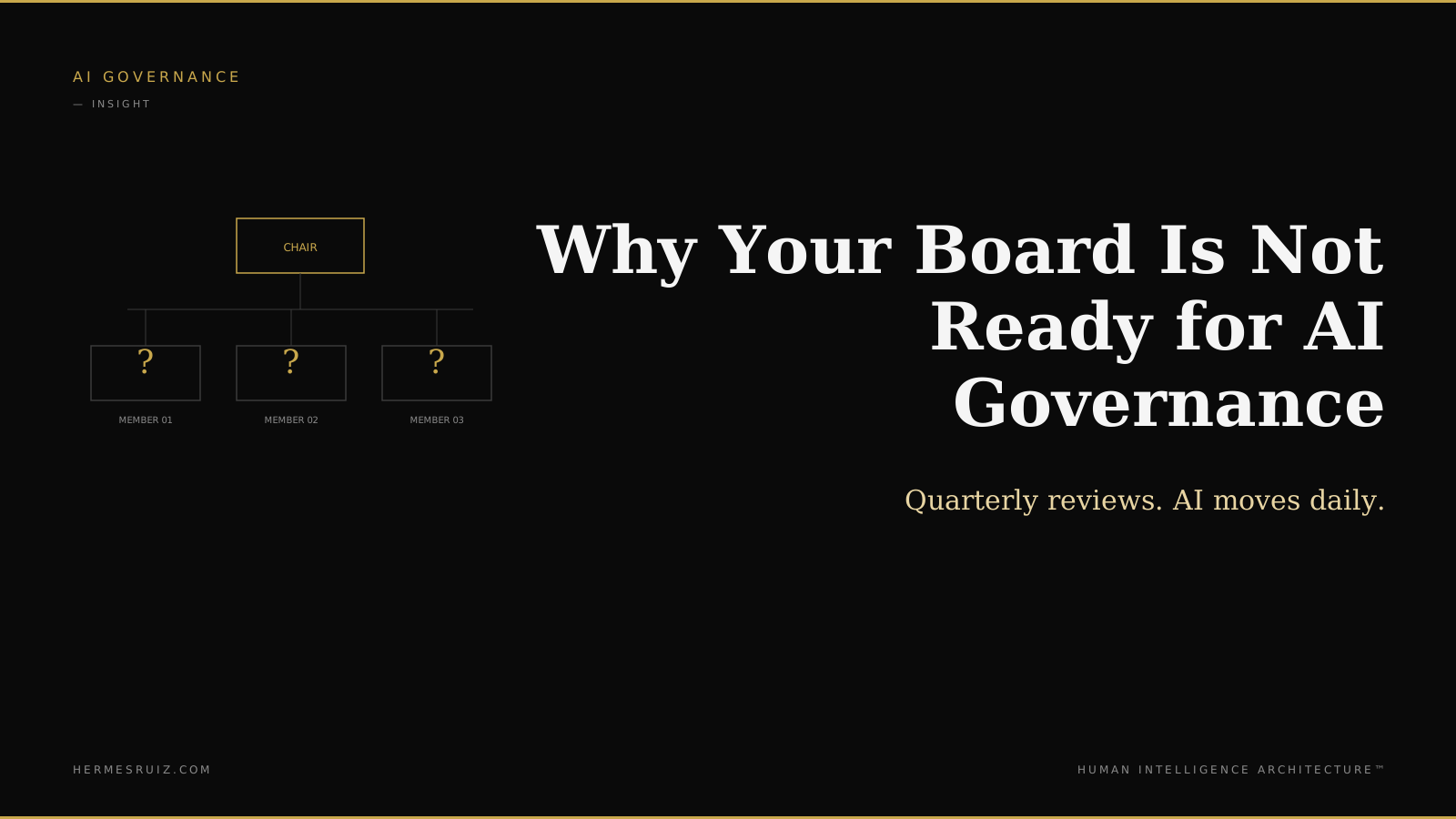
# Why Your Board Is Not Ready for AI Governance
The average board of directors is not equipped to govern AI. This is not an insult. It is a structural observation — and ignoring it has consequences that are already materializing.
## The Governance Gap
Boards were designed to govern businesses. They understand financial risk, legal exposure, reputational damage, and competitive dynamics — at a quarterly cadence, through documented reports, with established frameworks.
AI operates differently. It moves at a speed that makes quarterly reviews structurally inadequate. Its risks are probabilistic, not certain. Its failures are often invisible until they are catastrophic. Its decisions embed values — about fairness, privacy, and human dignity — that no financial model captures.
The average board member over 55 grew up in a world where technology was a support function. They delegated it. That instinct — born of rational specialization — is now a strategic liability.
## What Boards Are Actually Being Asked to Do
When a company deploys AI at scale, the board is implicitly approving decisions about:
- Which human decisions to automate and which to keep human
- What data the company collects, retains, and uses to train models
- How to handle AI-generated errors that harm customers or employees
- What the company's position is on AI replacing jobs
- How to respond when AI systems produce biased or harmful outputs
Most boards are approving these decisions without knowing they are making them. The CEO presents an "AI transformation roadmap." The board approves the budget. No one has a conversation about what is actually being decided.
## The Three Things a Board Needs
**1. AI literacy — not technical depth, but strategic fluency.**
Board members do not need to understand how transformers work. They need to understand what questions to ask. What data is this trained on? Who audits the outputs? What is the human override mechanism? These are governable questions that require no engineering degree.
**2. A board-level AI committee — not delegated to the audit committee.**
Audit committees handle compliance risk. AI governance is existential risk. It deserves its own structure, its own rhythm, and its own expertise.
**3. An external voice with no conflict of interest.**
The people who sell AI solutions have an interest in minimizing perceived risk. The people who build internal AI systems have an interest in protecting their work. Boards need advisors whose interest is aligned with long-term organizational health — not short-term implementation momentum.
## The Cost of Waiting
Every quarter a board operates without AI governance capacity is a quarter of decisions being made by default. Defaults, in AI, are not neutral. They are choices — about whose interests are served, whose risks are externalized, and what kind of organization you are building.
The board that acts first does not just reduce risk. It builds the institutional intelligence that will define competitive advantage for the next decade.
More perspectives
Want to discuss this?
Hermes Ruiz works with executives who take these questions seriously.
Book Hermes →